
AI Is an Amplifier: Fix the Platform Before You Scale the Agents
DORA's 2025 report finds AI amplifies whatever system it lands in. An npm worm and a major AWS outage this fall show why the internal platform is where to invest before scaling agents.
Last year's DORA report delivered an uncomfortable finding. More AI adoption went along with slightly lower delivery throughput and stability. This year the picture has changed, and the explanation for the change matters more than the numbers.
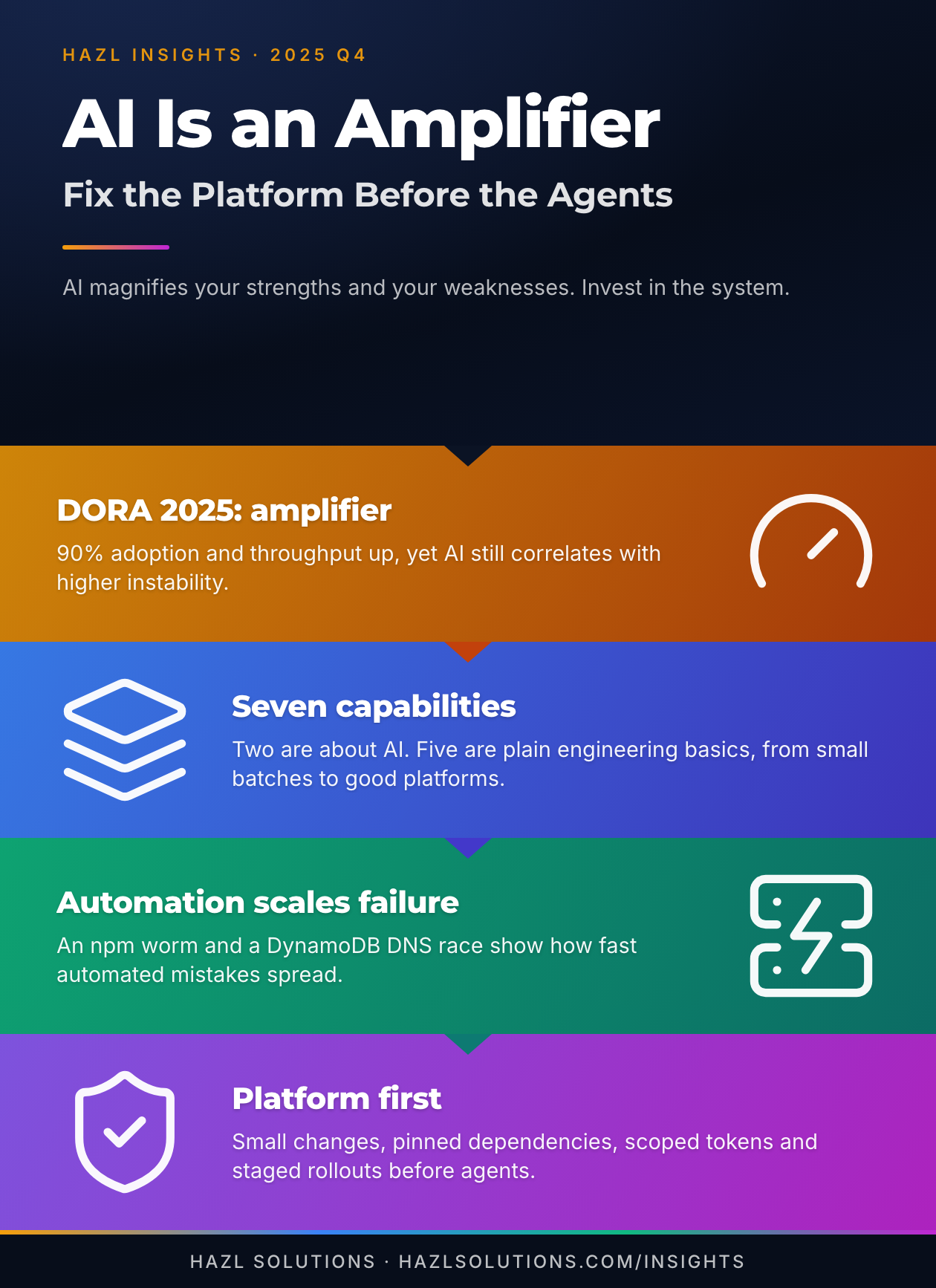
The 2025 DORA report, renamed the State of AI-assisted Software Development, puts its main conclusion plainly: AI's primary role is as an amplifier, magnifying an organization's existing strengths and weaknesses.
That's good news for teams with solid foundations. For everyone else it's a warning: rolling out more agents won't fix a shaky delivery system, it will make the weaknesses show up faster.
What DORA found this year
According to Google's summary of the report, released September 23, AI adoption among software professionals reached 90%, up 14% from last year. Over 80% of respondents say AI has improved their productivity, yet 30% trust its output only a little or not at all. Google calls that a trust paradox.
AI adoption is now linked to higher delivery throughput, which reverses last year's result. But stability hasn't caught up. As Thoughtworks' summary puts it, AI still correlates with higher instability, which shows that systems must adapt.
The most useful part of the report is the new DORA AI Capabilities Model: seven capabilities that amplify or unlock AI's benefits. Here they are:
- A clear and communicated AI stance
- Healthy data ecosystems
- AI-accessible internal data
- Strong version control practices
- Working in small batches
- User-centric focus
- Quality internal platforms
Look at that list again. Only two of the seven, a clear AI stance and AI-accessible internal data, are specifically about AI. The other five are plain engineering basics that describe any well-run engineering organization.
This fall, the amplifier worked in both directions
Two events this fall show how automation scales failure as easily as success.
On September 23, the same day DORA published, CISA warned of a self-replicating worm in the npm ecosystem, known as Shai-Hulud, that had compromised over 500 packages. It looked for GitHub tokens and cloud API keys, sent them to the attackers, and used the compromised developers' npm access to publish infected versions of other packages. CISA's guidance included pinning dependencies to releases from before September 16, rotating all developer credentials, and requiring phishing-resistant MFA.
Now imagine coding agents installing dependencies on their own, on machines that hold those same tokens. A worm that spreads through developer credentials spreads faster when more of the installing is automated.
Then on October 19 and 20, AWS had a long disruption in us-east-1. Its post-event summary traces it to a latent race condition in DynamoDB's automated DNS management. The automation removed every IP address for the regional endpoint, and engineers had to fix it manually. The failure cascaded into EC2 launches, Network Load Balancers, Lambda and more. AWS has disabled that DNS automation worldwide until safeguards are in place.
That wasn't an AI failure. It was an automation failure at a company with some of the best operations teams anywhere, which is exactly why it's worth studying. Automation without limits on how fast and how widely it can act amplifies a mistake as efficiently as it amplifies a fix.
The platform is the lever
If AI amplifies the system it lands in, the place to invest is the system. In practice that means the internal platform your teams and agents ship through. Before you scale agents, check that your platform gives them:
- Small, reviewable changes. Limits on change size and required reviews, so an agent's speed turns into many small merges rather than a few huge ones.
- Fast, trustworthy tests. Agents can only move as safely as your test suite is reliable.
- Pinned, proxied dependencies. Lockfiles, an internal package proxy and a short delay before new upstream versions are allowed in.
- Scoped, short-lived credentials for every agent and pipeline, so a stolen token is worth little.
- Progressive delivery. Canaries, staged rollouts and fast rollback, plus limits on how much any single automated action can change at once.
- Good internal data access. Documented, permissioned APIs to internal data, so agents don't scrape or guess.
What we recommend
Treat the DORA capabilities as a readiness checklist rather than a reading list:
- Score your organization honestly against the seven capabilities. Fix the two weakest before buying more AI seats.
- Write down and share your AI stance: which tools are allowed, with what data, and where experimentation is encouraged.
- Run CISA's npm checklist now if you haven't, and add an internal package proxy if you don't have one.
- Review every automated system that can change production, AI or not, and ask what caps how fast and how widely it can act.
- Track instability metrics, such as change failure rate and rework, alongside any productivity gains you report.
AI will make a good platform better and expose a weak one faster. The practical work of 2026 is making sure yours is the first kind.
Platform engineering for AI-assisted teams is the core of what HAZL's DevOps engineers do, if you'd like help assessing yours.